How long does cold brew last in the fridge?
No study sets a safe limit for home cold brew. In sealed lab bottles, bacteria stayed out for 6 weeks while sour, stale flavors crept in.
- Bacteria at every check, days 0–42
- <25CFU/mLSource [1]
- Storage tracked by a tasting panel
- 42daysSource [1]
- Largest pH drop, 90 days at 4 °C
- 0.24pH unitsSource [2]
- Added pathogens still alive at 4 °C after
- 60daysSource [2]
- FDA limit, refrigerated ready-to-eat food (restaurants)
- 7daysSource [3]
The data
There isn’t much. Two peer-reviewed studies followed plain, refrigerated cold brew over weeks, and only one of them tasted it.
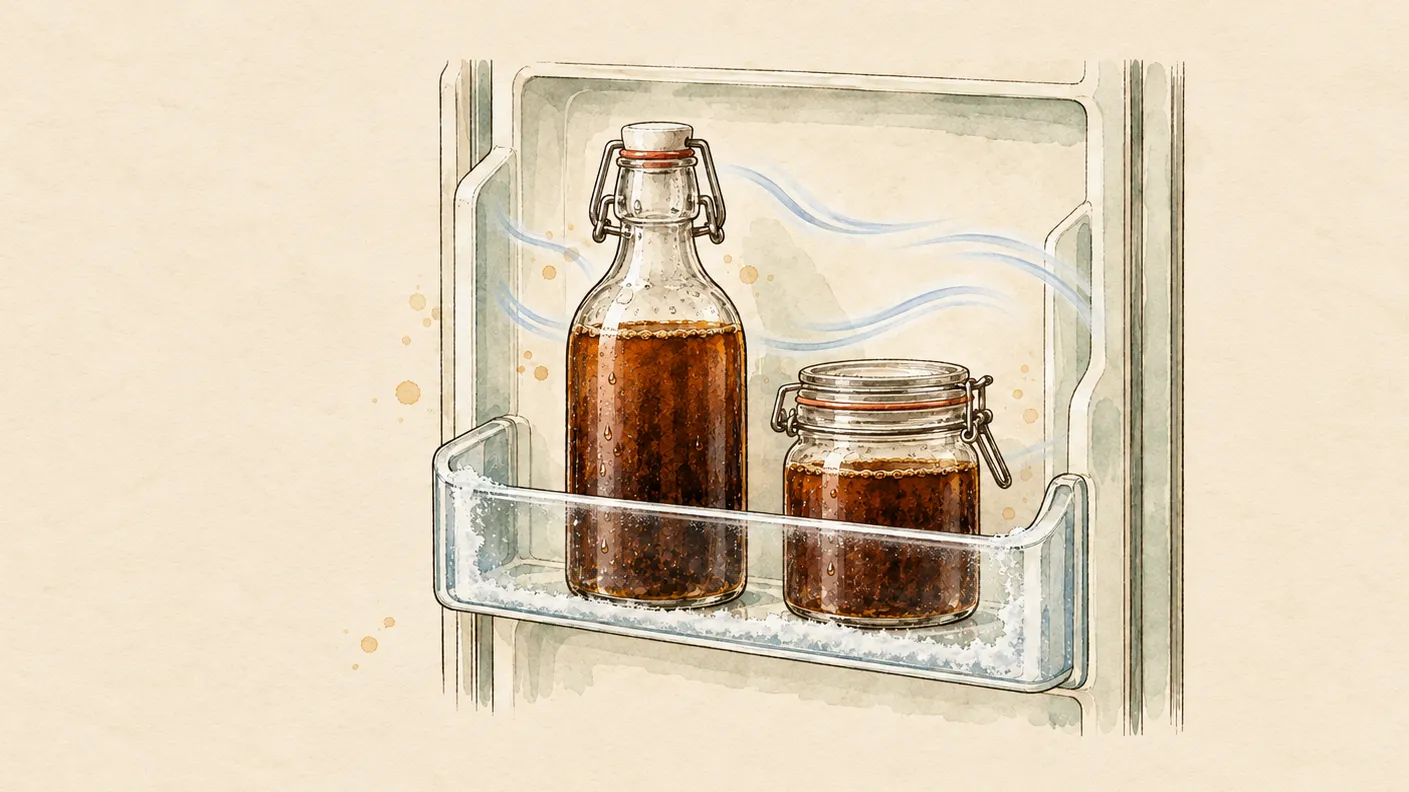
The tasting study. Lopane, McGregor and Rieck brewed one Brazilian coffee three ways: cold brew made in the fridge, cold brew made at room temperature, and hot drip chilled right after brewing. They bottled each in sealed 120 mL glass bottles and kept them at 7 °C for 42 days. Bacteria never showed up. Every sample stayed under 25 colony-forming units per mL at every check [1].
The flavor moved anyway. pH fell significantly in all three by day 42. Five trained tasters scored the coffee as less bitter over time and found more sour-fermented and papery-stale notes [1]. The authors conclude that in the fridge, flavor rather than microbes limits cold brew’s shelf life. They say the cause of the change is unclear. The day-by-day scores appear only inside the paper’s figures, so we describe them rather than re-plot them.
The bacteria study. Polanco-Estibález and colleagues steeped a commercial Arabica/Robusta blend for 17 hours at 4 °C and stored it in small sealed bottles for 90 days [2]. Untreated, its bacteria, yeast and mold counts stayed low for the whole 90 days. Its pH dropped by up to 0.24 units in the fridge, against 0.7 at room temperature. They didn’t taste it.
Then they spiked some bottles with E. coli, Listeria and Salmonella at about ten million cells per mL. None of the three grew in the fridge, and none disappeared. All three were still alive after 60 days at 4 °C [2]. Five of the seven authors work for a maker of high-pressure processing equipment, which is what the study set out to test. The untreated results reported here don’t depend on that.
| Tasting study (2024) | Bacteria study (2023) | |
|---|---|---|
| Brew | 4 h at 4 °C, 1:14, one coffee | 17 h at 4 °C, Arabica/Robusta blend |
| Stored | Sealed 120 mL glass, 7 °C, 42 days | Sealed small PET bottles, 4 °C, 90 days |
| Bacteria (clean samples) | Under 25 CFU/mL throughout | Low throughout |
| Added pathogens | Not tested | Survived at least 60 days, no growth |
| Flavor | Less bitter, more sour and stale by day 42 | Not tested |
The official number
The only official figure in the neighborhood is the FDA Food Code’s limit for refrigerated, ready-to-eat food that restaurants make and hold: at most 7 days at 5 °C (41 °F) or colder, with the day it was made counted as day 1 [3]. It’s a general food-safety rule and doesn’t mention cold brew.
Sealed containers are a different problem
Shelf-stable canned cold brew is classed as a low-acid product, so it has to be processed to prevent botulism [1]. Cornell’s Food Venture Center says there is no scientific information showing cold brew is safe in reduced-oxygen packaging such as nitrogen-infused cans [4]. That warning is about sealed, low-oxygen containers. A jar in your fridge is a different case, but the warning is still a good reason not to keep cold brew sealed at room temperature.
How they measured it
Lopane and colleagues, 2024. Each brew was made in triplicate and bottled into fifty sealed amber glass bottles at 7 °C. pH, titratable acidity and plate counts (total aerobic and cold-tolerant bacteria) were measured on days 0, 7, 14, 21, 28 and 42. A panel of five coffee sensory professionals tasted all three brews blind on days 0, 7, 14, 28 and 42, at 7 °C, and scored eleven attributes on a 0–15 scale.
Polanco-Estibález and colleagues, 2023. Cold brew in 30 mL sealed PET bottles, stored at 4 °C or 23 °C for 90 days, tested on days 0 to 90 for bacteria, yeasts, molds, pH, acidity and color. In a separate set, bottles were inoculated with five-strain cocktails of each pathogen and counted on the same schedule, in triplicate.
What the data can’t tell you
- Both studies stored cold brew in small sealed bottles, opened once. A home jar gets opened every morning, has air in it, and goes in and out of a fridge that may run warmer than 4–7 °C. Nobody has tested that.
- The tasting study made its cold brew in 4 hours in the fridge, at 1:14, from one natural-processed Brazilian coffee. A 16-hour concentrate from a different bean may age differently, by an amount nobody has measured.
- Five professional tasters reported statistically significant changes. That tells you the coffee changed, and nothing about the day it became unpleasant. No study offers a "most people notice by day X" number.
- The bacteria study added about ten million cells per mL, far more than a clean kitchen would. It shows cold brew doesn't kill pathogens quickly, and says nothing about how likely contamination is.
- Milk, cream, sugar and syrups weren't in any of it. Once you add them, these results stop applying.
- Spore-forming bacteria (the botulism kind) weren't tested in either study. The documented concern is sealed, low-oxygen containers like nitro cans. An open jar in the fridge isn't that, but no published test covers it either way.
- The FDA's 7 days is a general rule for restaurant food. It doesn't mention cold brew, and it isn't a home rule.
What to do at home
Brew in clean gear, keep it in the fridge, and plan to finish it within a week, which matches the FDA's general limit for refrigerated ready-to-eat food. Past a week, it's an untested call, and the one tasting study found flavor drifting across six weeks, so fresher is better anyway. Don't store cold brew sealed at room temperature. Brewing about a week's worth at a time keeps the question simple.
Size a batch for 7 servingsGear for this batch
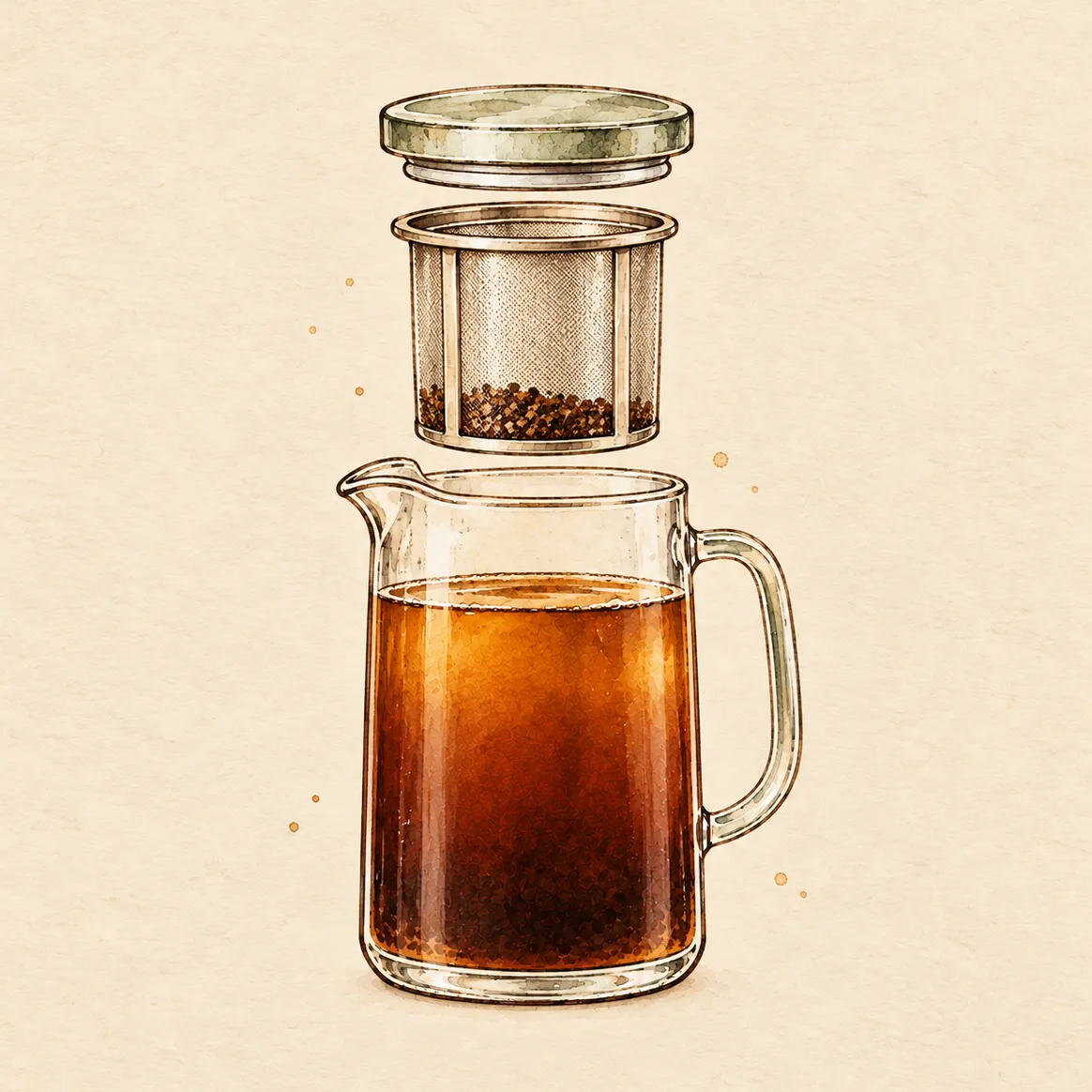
illustration Cold Brew Coffee Maker, 2 qt
View at takeyausa.com (opens in a new tab)illustration Mizudashi Cold Brew Coffee Pot, 1000 mL
View at hario-usa.com (opens in a new tab)
Sources
Lopane, S. N., McGregor, J. U. & Rieck, J. R. (2024). An investigation of the shelf life of cold brew coffee and the influence of extraction temperature using chemical, microbial, and sensory analysis. Food Science & Nutrition 12(2), 985–996. doi:10.1002/fsn3.3812 peer-reviewed
Polanco-Estibález, B., García-Santa-Cruz, R., Queirós, R. P., Serment-Moreno, V., González-Angulo, M., Tonello-Samson, C. & Rivero-Pérez, M. D. (2023). High-Pressure Processing for Cold Brew Coffee: Safety and Quality Assessment under Refrigerated and Ambient Storage. Foods 12(23), 4231. doi:10.3390/foods12234231 peer-reviewed
U.S. Food and Drug Administration (2022). Food Code 2022, § 3-501.17 (January 18, 2023 version). U.S. Department of Health and Human Services. fda.gov regulatory
Xavier, B. (2017). Cold brew coffee is keeping me awake… and it's not the caffeine. Cornell Food Venture Center blog. blogs.cornell.edu technical blog
Charts on this page are re-plotted from numbers printed in the sources’ text and tables. How the Lab picks and reads its sources
Four more questions from the Lab
- Does grind size matter for cold brew?7.06 %Extraction yield, medium grind (Huila, 14 h)Cordoba et al. 2019
- How long should cold brew steep?6–7 hCaffeine and 3-CGA level offFuller & Rao 2017
- What actually changes between cold brew and a French press?2.95 % TDSStrength, room-temp cold brew (23 °C, 8 h)Wang & Lim 2023
- Is cold brew actually less acidic?4.85–5.13pH, hot and cold (six coffees)Rao & Fuller 2018