Does grind size matter for cold brew?
In a filter bag, coarse grounds extracted about twice as much as medium. Caffeine barely cared about grind, and switching beans mostly moved acidity.
- Extraction yield, medium grind (Huila, 14 h)
- 7.06%Source [1]
- Extraction yield, coarse grind (same coffee)
- 15.21%Source [1]
- Coarse grind, average particle size
- 701–900µmSource [1]
- Top cold brew score (coarse, 14 h, Nariño)
- 4.3of 5Source [1]
The data
Every cold brew recipe says “coarse.” The textbook reason is that finer grounds extract faster and over-extract, and that holds up in hot brewing. Cold brew is murkier.
A 2019 study from Colombia brewed two coffees, from Huila and Nariño, at a medium grind (average particle size 501–700 µm) and a coarse one (701–900 µm), for 14 or 22 hours at 20 °C. Grind turned out to be the biggest single factor, ahead of steep time [1], and it worked backwards from the textbook. Coarse grounds extracted roughly twice as much as medium.
- Coarse (701–900 µm)
- Medium (501–700 µm)
see the numbers
| Coarse (701–900 µm) | Medium (501–700 µm) | |
|---|---|---|
| Huila, 14 h | 15.21 | 7.06 |
| Huila, 22 h | 20.39 | 9.40 |
| Nariño, 14 h | 15.73 | 9.36 |
| Nariño, 22 h | 19.05 | 10.72 |
Re-plotted from values reported in Table 1 of source [1]. The authors attribute the medium grind's low numbers to the grounds caking inside the filter bag.
The authors’ explanation is mechanical. The grounds steeped inside a filter bag, and the medium grind packed into a cake that water couldn’t move through well [1]. Read it as a result about bags, baskets and anything else that holds the grounds in one lump. A loose-grounds jar may behave differently, and nobody tested that.
The 14-to-22-hour jump is the steep-time question, covered in how long should cold brew steep?
The hot French press brews of the same coffees extracted 14.90 % and 15.20 %. The coarse cold brews matched them at 14 hours and passed them at 22.
The tasters agreed with the numbers. Coarse scored higher than medium or tied in every pairing, and the best cold brew of the study was coarse Nariño at 14 hours, with 4.3 out of 5 [1]. The hot brews scored 4.3 and 4.5.
- Coarse
- Medium
see the numbers
| Coarse | Medium | |
|---|---|---|
| Huila, 14 h | 3.8 | 2.5 |
| Huila, 22 h | 3.7 | 3.2 |
| Nariño, 14 h | 4.3 | 3.3 |
| Nariño, 22 h | 3.8 | 3.8 |
Re-plotted from values reported in Table 2 of source [1]. Cold brews were tasted at 19 °C.
Caffeine didn’t care much
A 2017 study tracked caffeine and one chlorogenic acid while steeping a Kona coffee at a medium and a coarse grind, also in a filter bag. After 24 hours the medium roast held 1,180 mg/L of caffeine at medium grind and 1,230 at coarse. For the dark roast it went the other way, 1,080 and 990. The authors concluded grind size had no significant effect on either compound [2]. Their reading is that over hours of contact, surface area stops being the bottleneck, so grind stops mattering for those two compounds. They also note their grind sizes weren’t tightly controlled, because the coffee came pre-ground from the roaster.
The bean mattered for acidity
In the Colombian study, the choice of coffee significantly moved pH and titratable acidity and nothing else. Nariño came out more acidic than Huila in all four conditions [1]. Same roast, same grinder, same water, same timer.
- Huila
- Nariño
see the numbers
| Huila | Nariño | |
|---|---|---|
| Coarse, 14 h | 0.61 | 0.75 |
| Medium, 14 h | 0.33 | 0.38 |
| Coarse, 22 h | 0.83 | 0.90 |
| Medium, 22 h | 0.37 | 0.54 |
Re-plotted from values reported in Table 1 of source [1]. Milligrams of chlorogenic acid equivalent per gram of coffee, titrated to pH 6.5.
How they measured it
Cordoba and colleagues, 2019. Two Colombian Caturra coffees, medium roast, ground on a commercial grinder and sized by sieve analysis. 60 g of coffee to 700 g of filtered water at 20 °C, grounds in a filter bag, 14 or 22 hours. All eight combinations were brewed twice and measured in triplicate: dissolved solids, extraction yield, pH and titratable acidity. Three trained tasters scored each cold brew from 0 to 5.
Fuller and Rao, 2017. One Kona coffee, roasted medium and dark and ground medium and coarse by the roaster. 35 g in a tea filter bag in 350 mL of water at 21–25 °C, sampled over 24 hours. Caffeine and 3-CGA were measured by HPLC. Sieve analysis showed the coarse grinds had more than 70 % of their mass on the 841 µm sieve.
What the data can’t tell you
- The coarse-beats-medium result comes from grounds steeped in a filter bag, where the medium grind caked. Loose grounds in a jar weren't tested, and there the usual rule (finer extracts faster) may well win.
- Two grind sizes, both on the coarse side. Neither study tried fine, extra-coarse, or a grind with lots of fines.
- Grind was described by average particle size. Fines, the dust that clogs filters and over-extracts, weren't measured, and two grinders on the same setting can produce very different amounts of them.
- Two coffees from one country, one variety, one roast. That's "origin" in the narrowest sense. We don't know if a Kenyan and a Brazilian would split the same way.
- The scores come from a panel of three trained tasters, tasting at 19 °C. That's a small panel.
- Room temperature only, and one ratio per study. Fridge brews and concentrates may respond to grind differently.
- One study measured dissolved solids and the other measured caffeine, so neither can check the other.
What to do at home
Grind coarse. With a filter bag or basket, coarse grounds extracted more and scored better than medium in the one study that compared extraction and taste across grinds. Switch beans and expect the acidity to change more than the strength. The Colombian study brewed at 60 g coffee to 700 g water and tasted it at 19 °C.
Open 1:11.7, ready to drink, in the calculatorGear for this batch
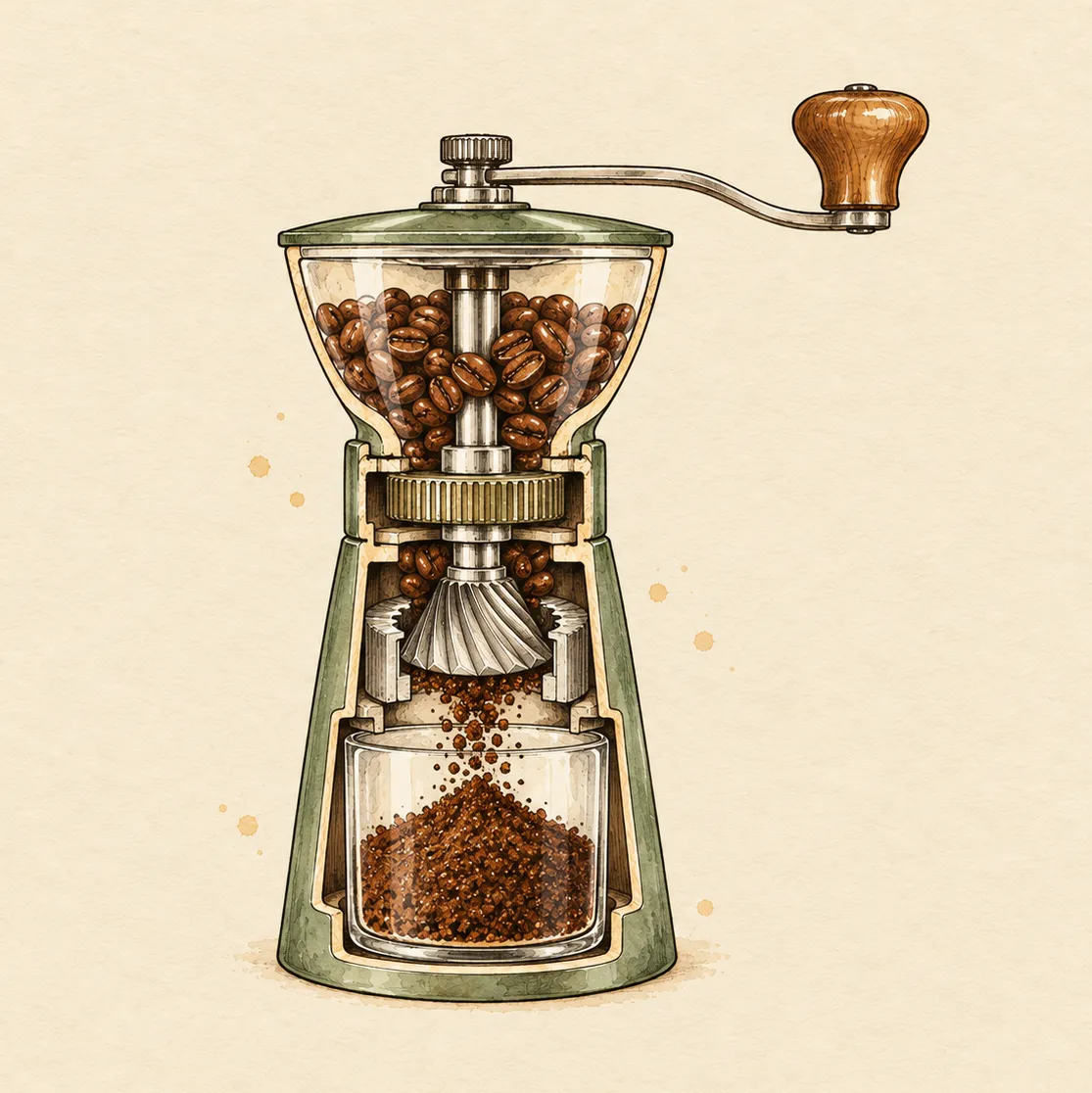
illustration illustration Skerton Pro Ceramic Coffee Mill
View at hario-usa.com (opens in a new tab)
Sources
Cordoba, N., Pataquiva, L., Osorio, C., Moreno Moreno, F. L. & Ruiz, R. Y. (2019). Effect of grinding, extraction time and type of coffee on the physicochemical and flavour characteristics of cold brew coffee. Scientific Reports 9, 8440. doi:10.1038/s41598-019-44886-w peer-reviewed
Fuller, M. & Rao, N. Z. (2017). The Effect of Time, Roasting Temperature, and Grind Size on Caffeine and Chlorogenic Acid Concentrations in Cold Brew Coffee. Scientific Reports 7, 17979. doi:10.1038/s41598-017-18247-4 peer-reviewed
Charts on this page are re-plotted from numbers printed in the sources’ text and tables. How the Lab picks and reads its sources
Four more questions from the Lab
- How long should cold brew steep?6–7 hCaffeine and 3-CGA level offFuller & Rao 2017
- What actually changes between cold brew and a French press?2.95 % TDSStrength, room-temp cold brew (23 °C, 8 h)Wang & Lim 2023
- How long does cold brew last in the fridge?<25 CFU/mLBacteria at every check, days 0–42Lopane et al. 2024
- Is cold brew actually less acidic?4.85–5.13pH, hot and cold (six coffees)Rao & Fuller 2018