What actually changes between cold brew and a French press?
At room temperature, 8 hours matched the French press for strength and caffeine, with higher pH and less titratable acid. The fridge brew came out weaker.
- Strength, room-temp cold brew (23 °C, 8 h)
- 2.95% TDSSource [1]
- Strength, French press (10 min)
- 2.95% TDSSource [1]
- Strength, fridge cold brew (4 °C, 20 h)
- 2.71% TDSSource [1]
- Brew kept by 1 g of spent grounds (approx.)
- 2gSource [1]
The data
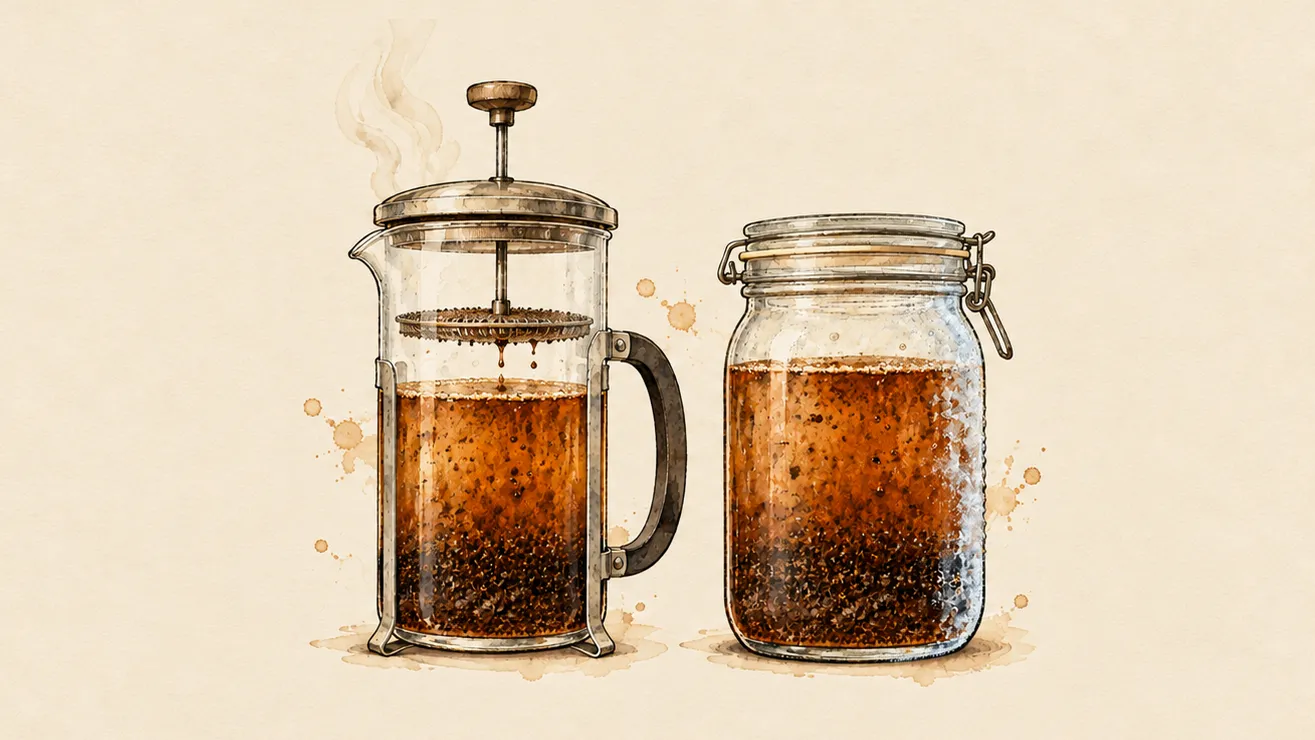
A 2023 study from the University of Guelph took one Colombian medium roast and brewed it every way that matters here: loose grounds in water at fridge, room and warm temperatures, at four ratios, and at five grind sizes. Then it put three brews side by side: cold brew from the fridge, cold brew from the counter, and a French press [1].
Temperature sets the pace
Warmer water extracted faster. After 5 minutes at a strong 1:3 ratio, the 4 °C brew had reached 3.6 % dissolved solids, against 5.8 % at 37 °C. By 18 hours the gap had mostly closed, though the fridge brew still trailed [1].
- 5 min
- 18 h
see the numbers
| 5 min | 18 h | |
|---|---|---|
| 4 °C (fridge) | 3.6 | 6.2 |
| 23 °C (room) | 5.1 | 6.8 |
| 37 °C (warm) | 5.8 | 7.0 |
Re-plotted from values reported in section 3.1 of source [1].
It all happened fast. With loose grounds, every temperature passed 90 % of its 18-hour strength within an hour, where bag-steeped studies like the one behind our steep-time file took closer to 7 hours. The authors put that down to the bag slowing things. They also note that the compounds behind body (polysaccharides, proteins, melanoidins) probably keep dissolving well after the fast part is done.
With loose grounds, grind did what the textbook says. After 5 minutes the finest grind (282 µm) was at 93 % of its final strength and the coarsest (1,057 µm) at 61 %. That’s the opposite of the bag result in our grind-size file, and it’s a good reason to treat that one as a bag result.
Cold vs hot, same coffee
For the head-to-head, all three brews were made in a French press at 1:6. One sat 20 hours in the fridge, one sat 8 hours on the counter, and one got 10 minutes with just-off-boiling water. The counter cold brew and the French press came out at the same strength, 2.95 %. The fridge brew reached only 2.71 %, despite its 20 hours [1].
At matched strength, the cold brews still had a higher pH and less titratable acidity.
see the numbers
| pH | |
|---|---|
| Fridge, 4 °C, 20 h | 5.38 |
| Room temp, 23 °C, 8 h | 5.34 |
| French press, 10 min | 5.18 |
Re-plotted from values reported in Table 1 of source [1]. All three differ significantly by the authors' Tukey test.
see the numbers
| Titratable acidity | |
|---|---|
| Fridge, 4 °C, 20 h | 0.86 |
| Room temp, 23 °C, 8 h | 0.87 |
| French press, 10 min | 0.97 |
Re-plotted from values reported in Table 1 of source [1]. The two cold brews don't differ significantly from each other; both differ from the French press.
Caffeine and chlorogenic acid in the counter cold brew were statistically the same as in the French press. The fridge brew had less of both, in line with its lower strength. The cold brews were also lighter in color and slightly less viscous [1].
Why your yield is smaller than your water
Spent grounds hold on to brew. From preliminary runs, the authors estimate each gram of grounds keeps about 2 g of liquid. The stronger the ratio, the bigger that loss is as a share of the batch. At 1:3, only 6.8 % of the coffee’s mass ended up in the brew you could pour off, against 16.56 % at 1:11 [1]. That ~2 g figure is the same one our calculator uses for expected yield.
see the numbers
| Actual extraction yield | |
|---|---|
| 1:3 | 6.80 |
| 1:6 | 13.64 |
| 1:9 | 16.10 |
| 1:11 | 16.56 |
Re-plotted from values reported in section 3.2 of source [1]. The authors estimate about 2 g of brew stays in each gram of spent grounds.
How they measured it
Sixty grams of coffee per batch, from a single roast batch, ground on a burr grinder and sized with a particle size analyzer. For the timing runs, loose grounds were stirred into tap water in sealed glass beakers at 4, 23 or 37 °C, sampled at 5, 10, 30 and 60 minutes and 18 hours, and paper filtered. Strength was read on a coffee refractometer. pH was measured directly, and titratable acidity by titrating to pH 7.0. Caffeine and chlorogenic acid were measured by HPLC. Differences in the cold-vs-hot table were tested with Tukey’s test. There was no tasting panel.
What the data can’t tell you
- Nobody tasted anything, so "less acidic" here means pH and titratable acidity. The authors suggest that's why people find cold brew less acidic. They didn't test it.
- The paper never says how many times each brew was repeated, or whether its ± figures are standard deviations or standard errors.
- The French press is described as 720 g of water on 60 g of coffee, which is 1:12, while the paper calls it 1:6. Matching strength suggests 1:6, but we can't confirm which number is the typo.
- The French press used the coarsest grind. The paper doesn't say what grind the two cold brews used.
- The timing experiments sampled at 5, 10, 30 and 60 minutes, then jumped straight to 18 hours, so they can't tell 8 hours from 12 from 18.
- Those timing runs were at 1:3, far stronger than anything you'd drink. The weakest ratio tested was 1:11, and ready-to-drink recipes run weaker still.
- One Colombian medium roast from one batch, brewed with Ontario tap water. Other beans and other water are anyone's guess.
- Loose grounds reached most of their final strength within an hour here, much faster than in bag-steeped studies. The authors blame the bags. They didn't test bags side by side, so it stays a guess, if a strong one.
What to do at home
To match French press strength, brew on the counter: 8 hours at 1:6 did it. A fridge brew at the same ratio comes out weaker, even at 20 hours, so use more coffee. Either way, expect a higher pH and less titratable acid than hot coffee. At 1:6 that's concentrate strength, so dilute to taste.
Open a 1:6 concentrate in the calculatorGear for this batch
illustration BEAN Cold Brew Coffee Maker, 1.5 L
View at bodum.com (opens in a new tab)
illustration V60 Drip Scale
View at hario-usa.com (opens in a new tab)
Sources
Wang, X. & Lim, L.-T. (2023). Effects of grind size, temperature, and brewing ratio on immersion cold brewed and French press hot brewed coffees. Applied Food Research 3, 100334. doi:10.1016/j.afres.2023.100334 peer-reviewed
Charts on this page are re-plotted from numbers printed in the sources’ text and tables. How the Lab picks and reads its sources
Four more questions from the Lab
- Does grind size matter for cold brew?7.06 %Extraction yield, medium grind (Huila, 14 h)Cordoba et al. 2019
- How long should cold brew steep?6–7 hCaffeine and 3-CGA level offFuller & Rao 2017
- How long does cold brew last in the fridge?<25 CFU/mLBacteria at every check, days 0–42Lopane et al. 2024
- Is cold brew actually less acidic?4.85–5.13pH, hot and cold (six coffees)Rao & Fuller 2018